Monday, May 19, 2014

INDIAN SUPER HERO

Super-heroic ventures

RASHMI PRATAP
SHARE  ·   COMMENT   ·   PRINT   ·   T+  
  • Modern mythmaking: Despite a fading market, Mumbai-based Karan Vir Arora launched Vimanika Comics in 2008, banking on innovative formats and merchandising to attract new readers
    Shashi AshiwalModern mythmaking: Despite a fading market, Mumbai-based Karan Vir Arora launched Vimanika Comics in 2008, banking on innovative formats and merchandising to attract new readers
  • Comic timing: Yearning for an all-Indian superhero, the Gupta siblings Manish (CEO), Manoj (president) and Sanjay (studio head) launched Raj Comics in 1986.
    Kamal NarangComic timing: Yearning for an all-Indian superhero, the Gupta siblings Manish (CEO), Manoj (president) and Sanjay (studio head) launched Raj Comics in 1986.
  • Manas Mohan, COO ACK Media, which owns vintage comic brand Amar Chitra Katha
    Manas Mohan, COO ACK Media, which owns vintage comic brand Amar Chitra Katha

Comic timing: Yearning for an all-Indian superhero, the Gupta siblings Manish (CEO), Manoj (president) and Sanjay (studio head) launched Raj Comics in 1986.

In the mid-1980s, when Phantom, Mandrake and Flash Gordon — the dashing supermen from Indrajal Comics — ruled the hearts and bookshelves of children in India, three brothers in Delhi were busy dreaming up an army of all-Indian superheroes. Like their famous western counterparts, the home-grown superheroes too would effortlessly grasp falling cars, send villains and their cronies flying into outer space, kill the baddies and heal the victims of injustice.
Coming from a family that had been in the publishing business for two generations, the siblings Sanjay, Manish and Manoj Gupta didn’t need to think twice before entering the comics space in 1986. Research, brainstorming and meetings with designers and artists followed, at the end of which was born Nagraj — the longest-running Indian comic superhero. Despite the competing attractions of television and the Internet, each new issue of Nagraj comics sells at least half-a-lakh copies even today.
Cut to Bangalore; circa 2014. Arun Prasad zealously collects comics — old and new. He has over 15,000 rare comics, including the first prints of Amar Chitra Katha, Indrajal and Tinkle. These early editions are a prized possession today. In Mumbai, for instance, you can come across roadside vendors selling vintage comics for anything from ₹3,000 to ₹50,000 each, depending on the publication date, the buyer’s passion and the seller’s business acumen. In fact, for the higher-priced ones, the buyer is asked to deposit the money in the vendor’s account before the comic can change hands!
This, then, is the world of comics — dominated by passionate readers, collectors, sellers and creators. Yet, the one thing that stands out today is the age group of the readers. These are not kids, rather they used to be the kids and teenagers in love with comics in the 1980s and 1990s, who are now trying to rekindle the magic. Today’s children, on the other hand, find entertainment in mobiles and tabs, leaving their parents to fawn over the comics.
Splurging on nostalgia
At Comic Con India, the annual comics convention held in the country since 2011, the median age of visitors is 21 and children are hardly seen here. “People consuming comic books today are above 18. Some readers spend ₹50,000 a month to buy comics. They are no longer the domain of kids,” says Comic Con organiser Jatin Varma. Nostalgia is a major factor, he adds.
Yesterday’s comic-loving kid is today’s high-earning professional who thinks nothing of splurging on a cherished part of childhood. Sample this: a vintage lot of 47 Flash Gordon Indrajal comics is available for auction on eBay at a base price of $648.70 (₹39,000), along with shipping charges of $80 (around ₹5,000). And bidding for a Phantom Indrajal vintage set of 128 comics in Bengali starts at $1,038.70 (around ₹63,000).
“Collection of vintage comics is a global phenomenon, which is now visible in India too,” says Manas Mohan, Chief Operating Officer at ACK Media, which owns Amar Chitra Katha and Tinkle publications.
The titles from Indrajal Comics, which began publishing in March 1964 and brought out its last issue in April 1990, are most in demand. Next in popularity are the vintage comics of Amar Chitra Katha, including the first title, Krishna, Shiva-Parvati and Nala-Damayanti, besides the early editions of Tinkle.
Fuzzy vintages
While the publishers look askance at those trading in comics at arbitrary prices, they are also happy to know that collectors are not willing to sell. “This renewed interest in comics impacts us positively by creating a higher decibel value for the brand,” says Mohan. ACK is growing at over 30 per cent annually in the ₹600-crore Indian comics industry.
But in all this mad rush for vintage comics, buyers often do not realise that what they think as the first edition of a comic might not necessarily be so. “The valuation process (of vintage comics) is still to be settled in the country. How do you make sure that a copy is from the first print-run of a particular comic? It is a complicated process,” says Mohan.
Varma points out that in the US, the Commercial Valuation Consultants (CVC) rates a comic book based on its preserved condition and its uniqueness — whether completely unavailable or signed by the creators and so on. On arriving at a valuation, it gives a stamp of approval specifying that the comic is of value and should be safeguarded.
“In India, some people sell comics dirt cheap and some sell at high premiums. I wish we had the wherewithal to regulate, so that people do not overpay,” says Varma.
Currently there is no information on the number of copies published for various titles decades ago, be they Indrajal, ACK or Tinkle. So ascertaining the real value of a comic book remains tricky.
Mohan believes buyers are largely punting right now, but adds that this “is a fairly short phenomenon and should be over soon”.
But that is precisely where the problem lies. If, and when the buzz around comics dies out, the publishers will be left at a loose end. Today’s networked kids prefer the live-action heroes to the 32-page-long battles that Nagraj typically wages.
Competing with TV
Observing that the demand for comics is not as robust as it used to be in the 1980s, Manish Gupta, CEO of Raj Comics, blames it on the declining interest in reading, as TV and the Internet emerge as the popular medium of entertainment.
The falling demand, in turn, leads to reduced space for comics at distributors’ warehouses. Ditto at the retailers. “Getting to the consumer is a challenge. Margins are high for distributors and small stores don’t even want to stock comics. And even if they agree, the payments are invariably delayed by up to six months, making it tough for publishers,” says Varma.
Despite the many challenges, Mumbai-based comic aficionado Karan Vir Arora went ahead and launched Vimanika in 2008. “Companies were not innovating. I thought it was time to do something different to regenerate interest,” he says.
His new-age comics brand derives its name from the Vaimanika Shastra, an early 20th century Sanskrit text on airborne vehicles. Vimanika’s superheroes are based on Hindu mythology — Lord Shiva, Kalki, Hanuman, Ganesha and the Dashavatars among others.
Unlike in Japan and Europe, comics in India have not mirrored the growth of the media and entertainment sector. “Comics here were not present in any other format. So we decided to take them beyond books,” says Arora.
The comics can be read online through a subscription. Moreover, Vimanika’s characters appear on t-shirts, posters, and other knick knacks, besides being available as sculptures and paintings. Today, 50 per cent of Arora’s revenues come from the sale of such merchandise. He has tied up with apparel firm Kapsons for the sale of Vimanika t-shirts in northern India. “We are also looking at a franchise model for selling merchandise and comics,” he says.
Old stories in new avatars
Like Arora, ACK, Diamond Comics and Raj Comics are trying different approaches to make their presence felt. The changes are visible at Landmark, Crossword and other organised bookstores that now have a few racks for Indian publishers, says Mohan.
The comics companies are also tapping the internet not just for selling books but also to attract young readers through apps for mobile phones and tablets. While some comics are available free with the app, others come for a fee.
Besides coming out with newer titles, publishers are advertising their titles, holding campaigns in schools and marketing them at public events. When ACK brought out a comic on the Carnatic musician MS Subbulakshmi, it tied up with the Chennai-based music association Narada Gana Sabha to launch the title at the association’s annual festival. “That brought us support from lovers of comics as well as music,” says Mohan.
Raj Comics, meanwhile, is making a feature film starring its superhero Doga. “It should be ready early next year,” says Gupta.
A hard copy of a comic book that was available for ₹5 in the mid-1980s is now priced ₹50. Adjusted for inflation, there is hardly any price increase. But publishers are anxious to keep prices low as they do not want to lose customers. Waging a crucial battle for readership, comics publishers will likely wish for some of the superpowers their comic heroes are so generously endowed with.
(This article was published on April 25, 2014)
Source:-thehindubusinessline.com

The Indian Superhero League

The Indian Superhero League: A Look at the Desi Avengers

If you are a comic book buff who grew up in the '90s, chances are that your childhood companion was either the snake-shooting Nagraj, or the calm and composed science dude Parmanu, or the hot-headed, gun wielding  Doga. Or all of them. Shockingly enough, despite their vibrant costumes and highly imaginative hairstyles, these beloved superheroes never made to the silver screen. In an effort to help Bollywood producers in case they take inspiration, here's our list of five Indian comic superheroes and the actors who could play them.      

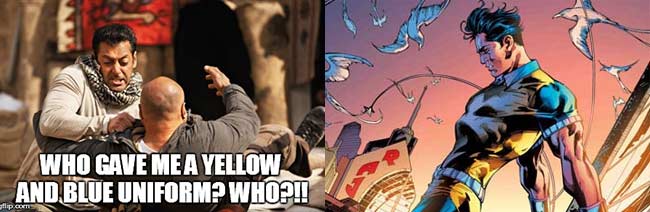
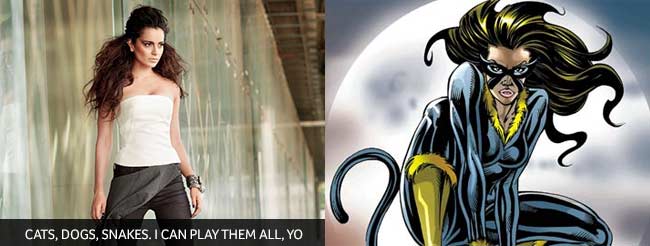
1. Super Commando Dhruv: He could swing like Tarzan, his right hook was enough to floor even the beefiest of goons, he wore a blue and yellow uniform and somehow made it work, and to top everything, he rode a motorcycle. Complete winner. The son of circus acrobats, Dhruv was adopted by a police officer after his parents passed away and lived in a city called Rajnagar. And although he didn't know this, it was Dhruv's sister from his adoptive parents who doubled up as the blonde-wig wearing superwoman Chandika, who sometimes showed up to help him. Kali Billi (obviously inspired by Cat Woman) was the morally questionable petty thief Dhruv often crossed paths with, but would rarely outsmart.

650_Salman_Dhruv.jpgActor(s): Salman Khan could easily play Super Commando Dhruv. Forget beefy goons, the man could probably crush trucks. Or at least tempos. Plus he would make the bikes look good. 

650_Kangana.jpgKali Billi could be played by Kangana Ranaut. No, no, no. Nobody question the Queen.   

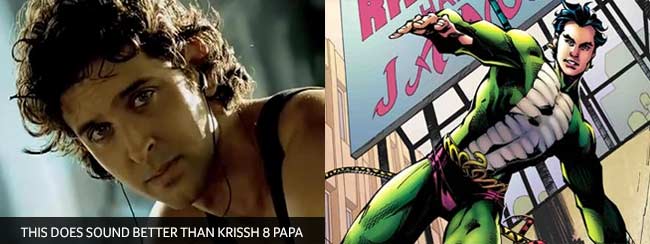
2. Nagraj: What's cool about Nagraj? Everything. Well-sculptured, snappy hair-do shaped like the hood of a snake, with a minty green snake-skin body, Nagraj specialised in fighting terrorists who disturbed his city, Mahanagar. Inspired by the web-casting Spiderman, Nagraj could shoot long lines of (real) poisonous snakes and could have mortified even Orcs, had he known they existed. The man had no vices either. He frequented pubs, yes. But drank only milk. It's true. Look it up. Oh, and his (alleged) love interest was a snake-woman, Saudangi, who lived inside his body and came out to help him whenever he was in trouble. Admit it. He sounds like the coolest superhero ever.

650_Hrithik.jpgActor(s): Leander Paes. Okayfine. Hrithik Roshan. Forget Krrish 8 or whatever number they are on. This is where the money's at, Mr Rakesh Roshan. Priyanka Chopra could play snake-woman Saudangi and look 'charming' while doing so.  
3. Doga: This muscular superhuman was quite in dogue at one point of time. Umm... vogue. We mean vogue. He wore the mask of a dog, beat bad men into a pulp and whenever required, used an ultrasonic whistle which attracted dogs the same way the Pied Piper's flute attracted children. Only these dogs weren't lead to a river but rather came to Doga's rescue in almost every fight. Adopted and brought up by a dacoit, Halkan Singh, Doga grew up in the company of dogs and understood their language just as they understood his. This series did much for the reputation of street dogs back then. 

650_John.jpgActor: John Abraham. The name is enough. End of matter. 
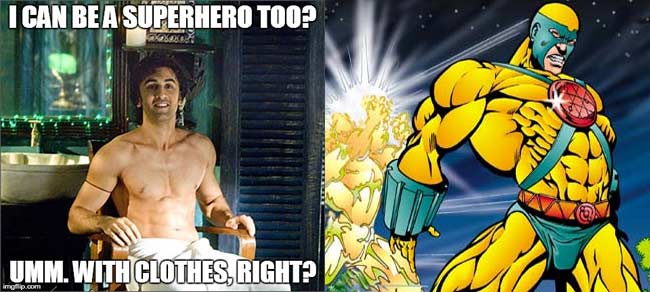
4. Parmanu: A Delhi police inspector by day and a vigilante by night, Parmanu was the science nerd's representative in the comic book community. He wore a special yellow-green suit designed by his scientist uncle which helped him 'create atoms' to destroy his enemies, fly, and even reduce and increase his size. Although he wasn't as popular as Nagraj or Super Commando Dhruv, but he deserves a mention for his 'contribution to science'. Or fashion.

650_RanbirK.jpgActor: Akshay Kumar. Or Ranbir Kapoor, if someone could coax him to not play a confused pseudo-adult for once.  

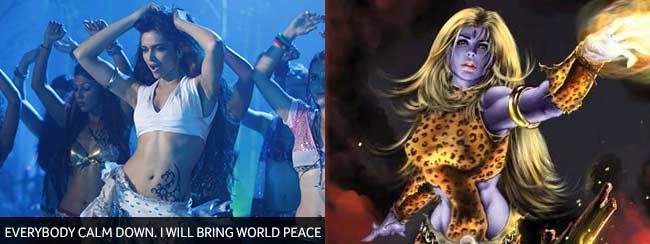
5. Shakti: Sadly, women did not have much of a spotlight as far as superheroes comics were concerned, except perhaps for Shakti. Blessed with powers from goddess Kali, she could turn any metal into a weapon and had the power of fire in her hands. She could turn goons into crispy marshmellows if she wished. And least we forget, the woman had a third eye. Enough said.

650_Deepika.jpgActress: Deepika Padukone wins this one hands down. She can rock the tiger skin clothes, the fairly temperamental third eye, make turning any metal into a weapon look believable, and can most certainly breathe fire. Or shoot it from her hands. Whichever. 
Interesting trivia: Amitabh Bachchan had a comic series dedicated to him (by his approval) in the '80s. Called The Adventures of Amitabh Bachchan, the superhero was named Supremo, and was the alter ego of the superstar himself in the comic. To make things even more interesting, Supremo had a falcon and a dolphin to help him from time to time. Wait. So a bird, a non-violent mammal and an angry young man made a crime-fighting team? Absolute awesomesauce. Wonder why they didn't make a film on this back then. 
source:-ndtv.com

Devi Chaudhurani

The story Devi Rising

The story Devi Rising
Shamik Dasgupta's Devi Chaudhurani is not merely an adaptation. It is the writer's reinterpretation of the role of women in Indian comics

When was the last time you encountered a woman, part of an Indian graphic narrative, who wasn't over-intellectualised or sexualised? When was the last time you met a woman in the realm of Indian sequential art who could stand proud and say that the story isn't about her being blessed or being a victim? In fact, when was the last time you actually encountered a woman in Indian comics who managed to impress you even remotely? It's the seed of this very thought that was planted in Shamik Dasgupta's head while he was working on Virgin Comics' Sadhu a few years ago. 

Bankim Chandra Chattopadhyay's classic novel Devi Chaudhurani has been a personal favourite and a great source of inspiration for Dasgupta even when he was developing the storyline of Sadhu. After all, the novel is undeniably close to Bengalis who grew up in the company of books. Devi Chaudhurani - Matsanyaya, released by Yali Dream Creations, an American publisher, is the first of two volumes. Tracing the life of a young girl, Prafulla, the story introduces us to a woman who achieves the status of an indomitable dacoit queen without relying on her luck or feminine charms. 

From recreating characters to appeal to a global audience, to roping in artists from Brazil and Mexico, the journey has been quite an interesting one for Dasgupta. Not only has he had the opportunity to work on an idea close to his heart, he also had the liberty to represent Devi in an avatar that surprises those who picked up the book with preconceived notions. 

What was the toughest part of this adaptation? "Recreating 18th century Calcutta was the greatest challenge we faced. Without first person accounts to rely on, our job was based solely on old photographs, areas that have survived the test of time and our imagination," responds Dasgupta. And though the thought of "artistic liberties" is scary enough in the world of Indian comics, thankfully Dasgupta does not let us down. The line-drawing is impressive and the colouring leaves you wanting more. 

The introduction of a strong, sensible and practical female protagonist in the world of Indian comics is something I had been waiting for. And Dasgupta's interpretation of Devi made me realise how important these rare female characters are. It made me realise that this perhaps is a book all women should read just to cleanse their minds of thoughts that make them associate women in Indian comics with latex clad curves, Godly abilities and existential crises. In a world where misogynistic hate-crimes are escalating, it is important for women to know that they can overcome odds even when they are left to defend themselves all alone. 

The author is the co-founder of StripTease the Mag, a magazine about comics and graphic novels from all over the world
Source:-www.bangaloremirror.com

Tickle your funny bone

Tickle your funny bone

MADHUMITHA SRINIVASAN


SHARE  ·   COMMENT   ·   PRINT   ·   T+  

Take a break with some lively characters for company. Featured in some Indian comics, many of them have become household names. From Suppandi and Chacha Chaudhury to Feluda, these unforgettable characters provide us with timeless fun and laughter.

Make friends with your books this summer. These iconic fictional characters from Indian comics will keep you company for many summers to come. So sit back, relax and get entertained.
Chacha Chaudhary: He is everybody’s favourite chacha because he is intelligent and has the most interesting adventures, plus he has a giant with super powers, for a friend. Born in 1971 out of the imagination of comic artist Pran, Chacha Chaudhary solves mysteries, fights crooks and helps people using his super-fast brain, and with the help of Sabu the giant from Jupiter and chacha’s pet dog Rocket.
The characters in Chacha Chaudhary’s fictional life include a sharp-tongued wife and a truck that is half-human.
(Published by Pran Comics)
Suppandi: He is foolish but sincere. He is incorrigible but loyal. This famous simpleton leaves his employers dumb-struck and the readers rolling with laughter at his stupidity. No task is too easy for him — Suppandi is sure to goof it up! It is thus hard for him to remain employed in one house, and therefore you’ll get to read about his misadventures with different bosses every time.
(Published in Tinkle by Amar Chitra Katha Media)
Detective Moochwala: As the name suggest, Detective Moochwala was as famous for his crime-solving skills as he was for his unique moustache. Assisting him on his adventures were his pet dog Pooch and super gizmos. He “was” because the comic strip created by cartoonist Ajit Ninan in the 1980s was stopped in the early 1990s because the magazine “Target” in which it was published underwent changes.
Feluda: What happens when a creative filmmaker is inspired by the fictional super detective Sherlock Holmes? He creates his own fictional detective! Filmmaker Satyajit Ray’s famous comic character Feluda is a crime-solving detective who goes on several adventures solving crimes across the country and sometimes across the border too.
He is accompanied by his teenaged cousin Tapesh and at times by the bumbling crime writer Lalmohon Ganguli aka Jatayu.
(Initially written as short stories and novels, the adventures of Feluda were later published as comics by Ananda Publishers and more recently, by Penguin Books.)
Shikari Shambu: He is not your quintessential hunter — he is not brave, does not have a good aim and ventures out to capture man-eating leopards just to escape his nagging wife! Tinkle’s Shikari Shambu is scared of animals of every size, and yet is invariable thrown into the heart of chaos and trouble and a very dense jungle. Though he might not think it a laughing matter, for us it sure is funny to see how in spite of all his fumbling and bumbling he comes out victorious every single time, much to his own surprise!
Fact turned fiction
They may be real people with real impact on our history, but their fictional avatars are more popular with children and even help teach a thing or two about the importance of brains over brawn. Having made the successful transition from the royal courts to our comic strips are…
Birbal: Historically speaking, Birbal was an advisor to the Mughal emperor Akbar during the 16th century. Initially appointed as a poet and singer, Birbal became close to Akbar and ended up as his advisor on several administrative and military matters. Their interaction is the fodder for many folktales that emerged after their time, with emphasis on Birbal’s wit and intelligence. Many stories have jealous ministers of Akbar’s court plotting to outsmart Birbal before the king but fail miserable. The stories are all the more enjoyable because his wit is laced with humour making for a fun read thus fanning several comics based on the pair.
Tenali Raman: Tenali Ramakrishna or more populary known as Tenali Raman was Birbal’s contemporary in the South — a jester and poet in the court of Krishnadevaraya of the Vijayanagara Empire in the 16th century. Like Birbal, he was also known for his wit and humour. His importance in the court of King Krishnadevaraya has spawned several folktales which now make for popular comic plots. Right from helping catch a bunch of thieves to teaching a lesson to the greedy, his tales make for good entertainment.